
What to Do If a False 498A Case Is Filed Against You in India
Facing a false 498A case? Learn the immediate legal steps, arrest safeguards, anticipatory bail, evidence, FIR quashing and remedies available in India.
Read Guide
Verified Family Law Guides
Understand divorce procedures, child custody laws, maintenance rights, domestic violence protections, court marriages, alimony rules, and matrimonial disputes through expert-reviewed legal guides.
Growing collection of expert family law resources
Browse every expert-written family & matrimonial guide in this category
Facing a false 498A case? Learn the immediate legal steps, arrest safeguards, anticipatory bail, evidence, FIR quashing and remedies available in India.
Read Guide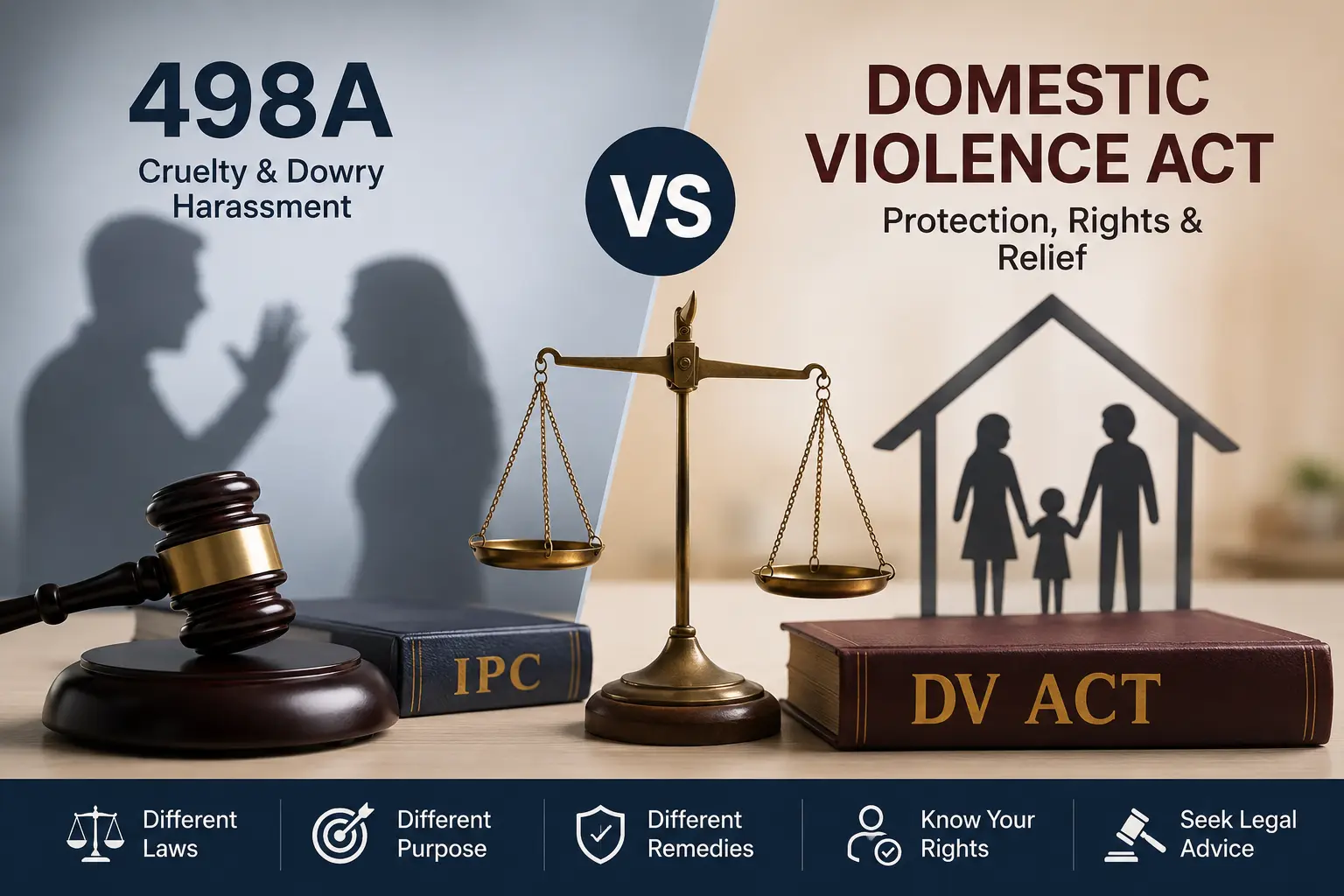
Learn the difference between a 498A case and a Domestic Violence case. Compare legal provisions, rights, remedies, maintenance, residence rights, and when both
Read Guide
Understand Section 498A (now covered under the Bharatiya Nyaya Sanhita), cruelty against a married woman, FIR process, bail, husband and wife rights, false case
Read Guide
Learn everything about divorce in India, including mutual consent divorce, contested divorce, legal process, costs, child custody, alimony, required documents,
Read GuideBrowse in-depth guides on key family & matrimonial topics in India
Connect with experienced advocates specializing in divorce, custody, and matrimonial disputes.


Discover more legal guides across related practice areas
Section 498A of the Indian Penal Code (now under the Bharatiya Nyaya Sanhita in applicable jurisdictions) makes cruelty by a husband or his relatives toward a married woman a criminal offence. It is often filed alongside dowry-related complaints in matrimonial disputes and can lead to police investigation, arrest, and trial. Legal advice is important for both complainants seeking protection and accused persons responding to allegations.
Mutual consent divorce typically takes six months to eighteen months depending on the cooling-off period and court workload. Contested divorce can take several years because of evidence, interim applications, and appeals. Timelines vary by court, complexity of custody or property disputes, and whether parties reach settlement.
Indian courts prioritize the welfare of the child over parental preference. Custody may be awarded to either parent, shared through joint custody arrangements, or supported by structured visitation. Factors include the child's age, emotional bond, schooling, safety, and each parent's ability to provide a stable home.
Courts consider the income, assets, and earning capacity of both spouses, the standard of living during marriage, duration of the relationship, and needs of children. Maintenance may be interim during proceedings and permanent after divorce. Different statutes such as Section 125 CrPC and personal laws may apply depending on the facts of the case.
Yes. On Xpertto you can book secure video or chat consultations with verified family lawyers across India. Online consultations help you discuss divorce, custody, maintenance, domestic violence, or 498A matters privately and receive guidance tailored to your situation.
Family law in India governs marriage, divorce, child custody, maintenance, domestic violence, adoption, and guardianship. The legal framework draws from personal laws applicable to different communities alongside secular statutes such as the Special Marriage Act and the Protection of Women from Domestic Violence Act. Whether you are considering separation, seeking child custody, filing a domestic violence complaint, or planning a court marriage, understanding your rights and procedural requirements is the first step toward protecting yourself and your family.
Divorce in India may be sought on fault-based grounds such as cruelty, adultery, desertion, or mental disorder, depending on the personal law applicable to the marriage. Petitions are generally filed in family courts with jurisdiction where the parties last resided together or where the marriage was solemnized. Courts examine evidence, attempt reconciliation where appropriate, and pass decrees that address maintenance, custody, and property arrangements alongside the dissolution of marriage.
Mutual consent divorce under Section 13B of the Hindu Marriage Act and parallel provisions in other personal laws allows spouses to separate by agreement when they have lived apart and mutually decide to end the marriage. The process typically involves two motions before the court with a statutory cooling-off period between them, though courts may waive this period in suitable cases. Parties must agree on maintenance, alimony, child custody, and division of assets before filing the joint petition.
Indian courts decide child custody based on the welfare of the child as the paramount consideration, not the gender of the parent. Custody may be granted as sole custody, joint custody, or visitation rights depending on the child's age, schooling, emotional needs, and each parent's ability to provide care. Guardians and Wards Act proceedings may run alongside divorce cases. Parents can also agree on parenting plans, which courts may endorse if they serve the child's best interests.
Maintenance laws in India include provisions under Section 125 of the Code of Criminal Procedure, the Hindu Adoption and Maintenance Act, the Domestic Violence Act, and personal laws governing interim and permanent alimony. Courts consider the income and earning capacity of both parties, standard of living during marriage, duration of the relationship, and the needs of dependent children. Maintenance can be awarded during pending proceedings and as a final order after divorce.
The Protection of Women from Domestic Violence Act, 2005 provides civil remedies including protection orders, residence orders, monetary relief, and custody orders for women facing abuse in a domestic relationship. Domestic violence includes physical, sexual, verbal, emotional, and economic abuse. Victims can approach magistrates, file complaints with protection officers, and seek shelter or medical assistance. Breach of protection orders carries legal consequences.
Section 498A addresses cruelty by a husband or his relatives toward a woman, including conduct likely to drive her to suicide or cause grave injury. It is a cognizable offence often invoked in matrimonial disputes alongside dowry prohibition laws. Understanding the difference between civil family remedies and criminal proceedings is essential, as 498A cases involve police investigation, bail considerations, and trial in criminal courts. Legal guidance helps parties navigate both protective and defensive strategies.
Court marriage under the Special Marriage Act allows couples of any religion to marry without religious ceremonies, subject to notice requirements, objection periods, and verification of age and consent. The marriage officer solemnizes the union and issues a marriage certificate recognized nationwide. Couples must meet residency and documentation requirements, and prior marriages must be legally dissolved. Court marriage is a practical option for inter-faith couples and those seeking a straightforward civil union.
Adoption in India is regulated by the Hindu Adoption and Maintenance Act, the Juvenile Justice Act, and guidelines for inter-country adoption through authorized agencies. Prospective parents must meet eligibility criteria, home studies, and court approvals. Guardianship under the Guardians and Wards Act appoints a legal guardian for minors when parents are unable to care for them. Family lawyers assist with petitions, documentation, and compliance with Central Adoption Resource Authority norms.
Family disputes are deeply personal and legally complex. Xpertto family law guides explain procedures, timelines, documents, and remedies in clear language so you can make informed decisions. When your situation requires tailored advice, verified family lawyers on Xpertto offer confidential video and chat consultations to guide your next steps.