
What to Do If a False 498A Case Is Filed Against You in India
Facing a false 498A case? Learn the immediate legal steps, arrest safeguards, anticipatory bail, evidence, FIR quashing and remedies available in India.
Read Guide
Verified 498A Legal Guides
Understand Section 498A IPC and Section 85 BNS, including anticipatory bail, arrest procedures, false cases, dowry harassment complaints, quashing petitions, and legal remedies through expert-reviewed legal guides.
Expert resources on Section 498A IPC and Section 85 BNS
Browse every expert-written article in this category
Facing a false 498A case? Learn the immediate legal steps, arrest safeguards, anticipatory bail, evidence, FIR quashing and remedies available in India.
Read Guide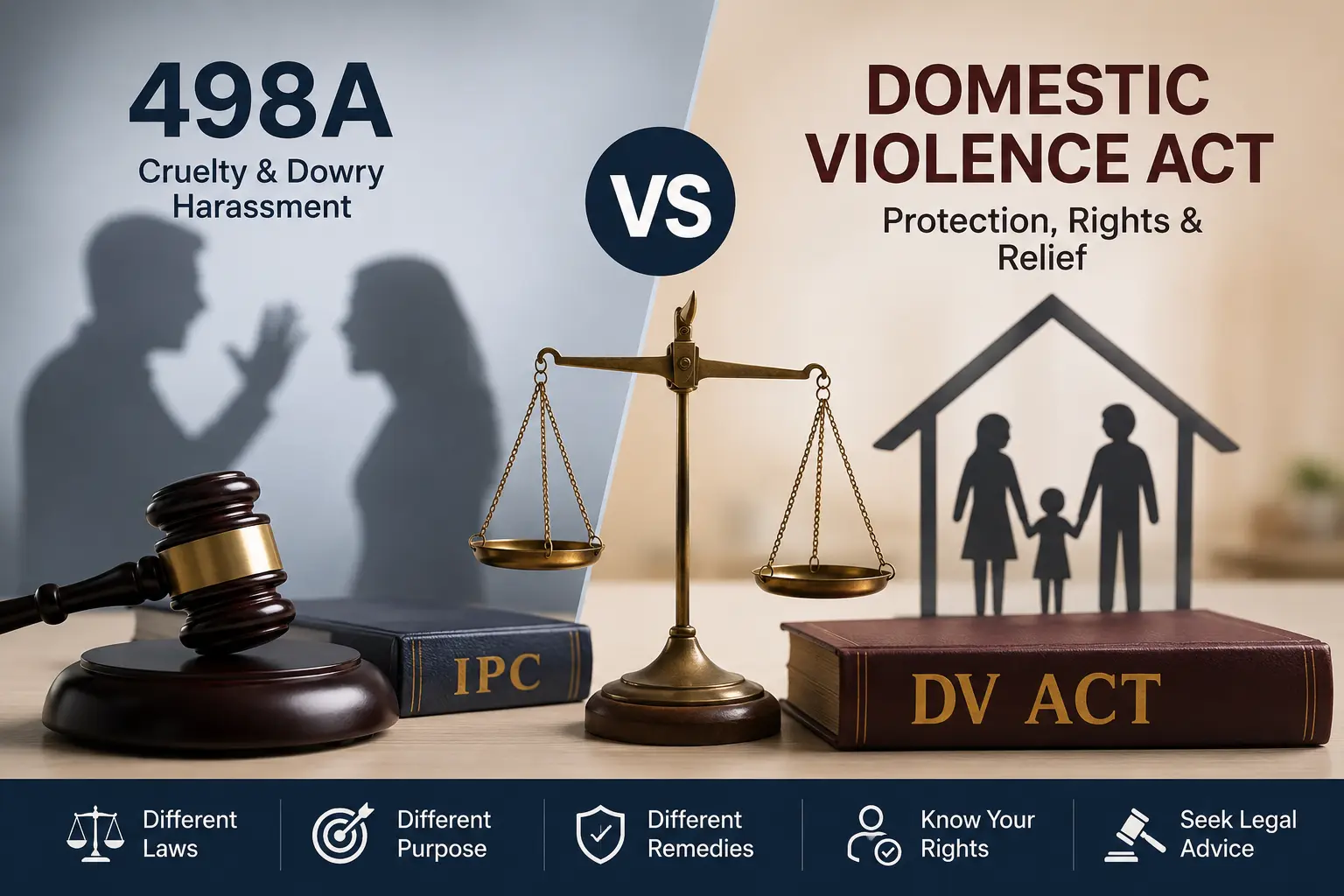
Learn the difference between a 498A case and a Domestic Violence case. Compare legal provisions, rights, remedies, maintenance, residence rights, and when both
Read Guide
Understand Section 498A (now covered under the Bharatiya Nyaya Sanhita), cruelty against a married woman, FIR process, bail, husband and wife rights, false case
Read GuideConnect with experienced advocates who handle anticipatory bail, quashing petitions, and matrimonial criminal defence.


Explore related family law guides and resources
Yes. A husband or accused relative can apply for anticipatory bail under Section 438 CrPC before the Sessions Court or High Court if arrest is apprehended. Courts consider the nature of allegations, cooperation with investigation, and whether custodial interrogation is necessary. Grant is not automatic and depends on the facts of each case.
Section 498A IPC is a cognizable offence and is generally treated as non-bailable, meaning bail is not a matter of right and must be sought from the court. Police may register the FIR and investigate without a warrant in many circumstances, subject to Arnesh Kumar safeguards on arrest. Section 85 BNS should be checked for equivalent classification under the new code.
Conviction under Section 498A IPC can lead to imprisonment up to three years and a fine. Section 85 BNS carries comparable punishment for cruelty in a matrimonial context. Actual sentencing depends on proven facts, aggravating circumstances, and prior record.
Yes, in appropriate cases. The High Court may quash an FIR or criminal proceeding under Section 482 CrPC if the allegations do not constitute an offence, amount to abuse of process, or are settled through lawful compromise. Quashing is discretionary and requires strong legal grounds supported by evidence and precedent.
Section 85 of the Bharatiya Nyaya Sanhita replaces Section 498A IPC under the new criminal code framework. It continues to address cruelty by a husband or relatives toward a woman, including harassment linked to unlawful demands. Applicable law depends on the date and facts of the alleged offence, and courts may refer to earlier 498A jurisprudence when interpreting similar conduct.
Parties may explore mediation or settlement, especially when matrimonial disputes overlap with criminal complaints. A formal compromise must comply with court procedure and may require approval before proceedings are withdrawn or quashed. Legal advice is essential to ensure the settlement is binding and does not leave either party exposed to future claims.
Section 498A of the Indian Penal Code has long been one of the most discussed criminal provisions in matrimonial disputes in India. It addresses cruelty by a husband or his relatives toward a married woman, including conduct linked to unlawful demands for dowry. With the introduction of the Bharatiya Nyaya Sanhita (BNS), similar conduct is addressed under Section 85. Whether you are seeking protection, responding to an FIR, or exploring bail and quashing remedies, understanding how these laws work in practice is essential for making informed legal decisions.
Section 498A IPC defines cruelty by a husband or his relatives toward a woman in a matrimonial relationship. Cruelty includes conduct likely to drive the woman to suicide or cause grave injury to her life, limb, or health, as well as harassment to coerce her or her relatives to meet unlawful demands for property or valuable security. Complaints are often filed alongside provisions relating to dowry harassment. The offence is cognizable and historically attracted significant police attention, making early legal advice critical for all parties.
The Bharatiya Nyaya Sanhita replaces the Indian Penal Code with updated criminal provisions. Section 85 BNS addresses cruelty by a husband or his relatives toward a woman, carrying forward the core concept of matrimonial cruelty and harassment linked to unlawful demands. While the statutory language and numbering have changed, courts continue to rely on established jurisprudence under Section 498A when interpreting similar conduct. Parties should verify which code applies based on the date and circumstances of the alleged offence and seek advice on transitional legal issues.
Conviction under Section 498A IPC could result in imprisonment up to three years and a fine. Section 85 BNS prescribes comparable punishment for cruelty in a matrimonial context. Beyond imprisonment, a criminal record affects employment, travel, and personal reputation. Sentencing depends on the severity of cruelty proven, prior conduct, and mitigating factors. Because the stakes are high, both complainants and accused persons benefit from understanding evidentiary requirements and available defences at each stage of the case.
The Supreme Court in Arnesh Kumar v. State of Bihar laid down safeguards against automatic arrest in offences such as Section 498A. Police officers must conduct a preliminary investigation, satisfy themselves about the necessity of arrest under Section 41 CrPC criteria, and document reasons before taking a person into custody. Magistrates are expected to review whether arrest is justified before authorizing detention. These guidelines aim to prevent misuse and ensure that arrest is not a routine consequence of every matrimonial complaint.
A husband or family member fearing arrest may apply for anticipatory bail under Section 438 CrPC before the Sessions Court or High Court. Courts weigh factors such as the nature of allegations, prior cooperation with investigation, risk of tampering with evidence, and whether custodial interrogation is necessary. Anticipatory bail is not granted automatically; strong legal drafting and supporting documents improve the chances of protection while the case proceeds. Interim protection and conditions such as joining investigation are commonly imposed.
Courts have acknowledged that some matrimonial complaints may be exaggerated or filed with ulterior motives during pending divorce or custody disputes. Accused persons can challenge the veracity of allegations through cross-examination, contradictory evidence, communication records, and witness testimony. However, labelling a case false without legal process can backfire. A structured defence strategy developed with an experienced advocate is safer than informal retaliation or non-cooperation with lawful investigation.
When an FIR or criminal proceeding is devoid of merit or constitutes an abuse of process, the accused may file a quashing petition under Section 482 CrPC before the High Court. Courts may quash proceedings if the allegations, even if taken at face value, do not disclose a cognizable offence, or if the dispute is predominantly civil in nature. Settlement between parties, lack of specific allegations against individual in-laws, and jurisdictional defects are among the grounds frequently argued. Quashing is discretionary and fact-intensive.
A wife lodging a complaint has the right to seek police protection, medical assistance, and legal remedies against cruelty and dowry-related harassment. A husband and accused relatives have the right to fair investigation, legal representation, bail where appropriate, and presumption of innocence until proven guilty. Both parties may access mediation, counselling, and parallel civil remedies in family courts for divorce, maintenance, and custody. Knowing these parallel tracks helps families avoid unintended escalation.
Many 498A matters intersect with ongoing matrimonial litigation. Courts and mediation centres increasingly encourage settlement when both parties are willing and allegations are capable of resolution through agreed terms on maintenance, custody, and withdrawal of complaints. A formal settlement should be documented with legal advice to ensure enforceability and proper filing before the appropriate court. Settlement does not automatically erase criminal consequences without court approval and compliance with legal procedure.
Parties typically need marriage certificates, complaint or FIR copies, bail applications, anticipatory bail orders, medical or injury reports, dowry lists, bank statements, chat and email records, witness statements, and prior court orders in related family matters. Accused persons should preserve evidence of residence, employment, and communication that contradicts allegations. Organized documentation strengthens bail, quashing, and trial strategies and reduces delays caused by incomplete filings.
Section 498A and Section 85 cases require careful navigation of criminal procedure, family law, and evolving Supreme Court guidelines. Xpertto publishes practical guides on anticipatory bail, false case defences, quashing petitions, and dowry harassment law so you understand your options before taking decisive steps. For personalized advice on your FIR, bail application, or settlement strategy, consult a verified family law advocate through confidential video or chat on Xpertto.