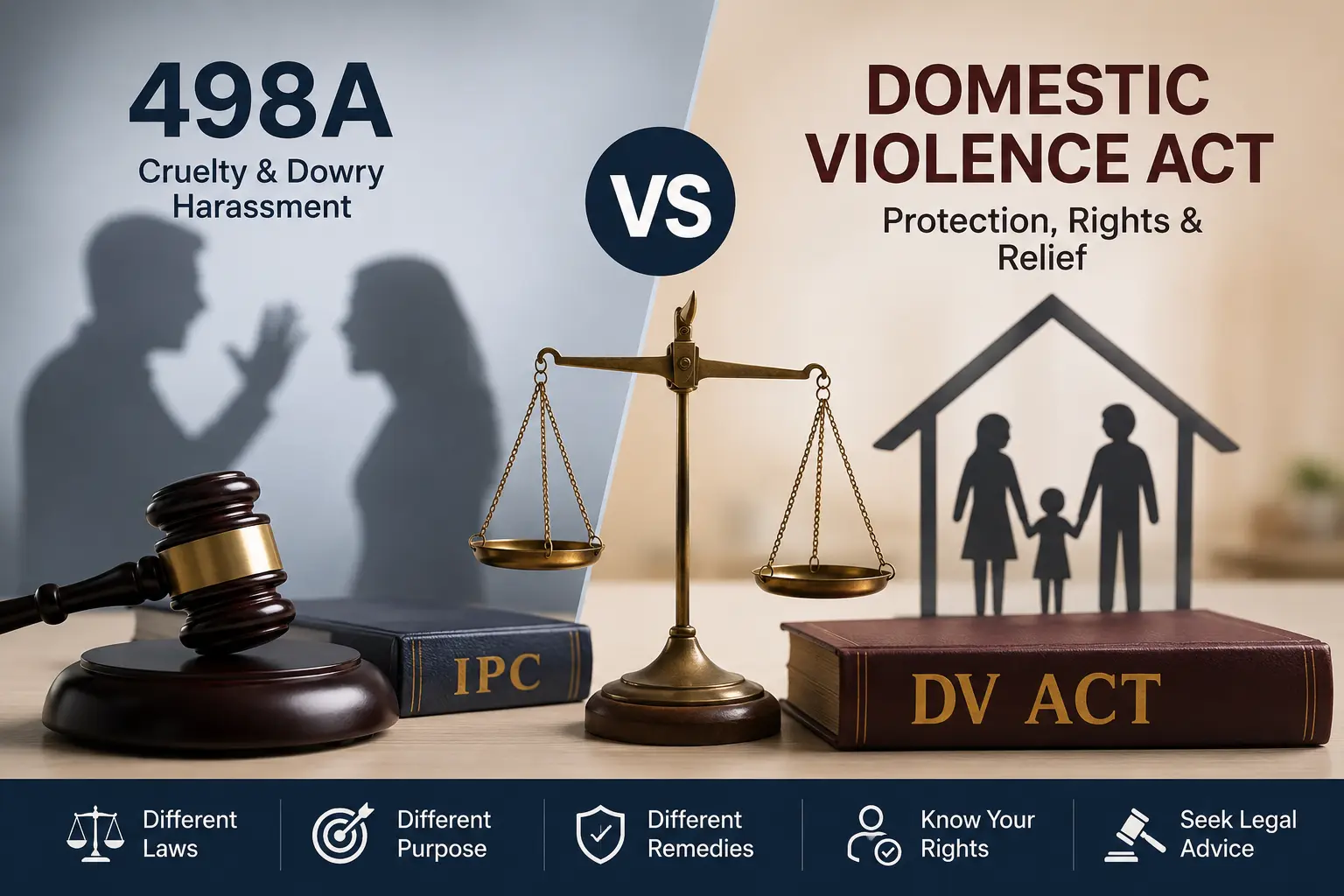
Marital disputes can involve emotional, financial, and legal challenges. Two of the most commonly discussed legal remedies in India are Section 498A (protection against cruelty by the husband or his relatives) and proceedings under the Protection of Women from Domestic Violence Act, 2005 (DV Act). Although these remedies are often mentioned together, they serve different purposes and operate under different legal frameworks.
Understanding the difference between a 498A case and a Domestic Violence case is important before taking legal action. Choosing the appropriate remedy depends on the facts of each case, the type of relief required, and the evidence available.
This guide explains how both legal remedies work, their key differences, and when legal advice should be sought.
What Is Section 498A?Section 498A of the Indian Penal Code (with corresponding protections continuing under the current criminal law framework) addresses cruelty by a husband or the husband's relatives toward a married woman.
Cruelty may include serious physical abuse, mental harassment, or unlawful demands for dowry. Proceedings under this provision are criminal in nature and may lead to investigation and prosecution if the legal requirements are satisfied.
The primary objective is to punish criminal acts of cruelty and provide legal protection to women facing serious abuse within marriage.
What Is a Domestic Violence Case?The Protection of Women from Domestic Violence Act, 2005 is a civil law that provides immediate protective and monetary relief to women experiencing domestic violence.
Domestic violence is broader than physical assault. It may include:
Physical abuse
Emotional or verbal abuse
Economic abuse
Sexual abuse
Threats or intimidation
Controlling behaviour
The focus of the DV Act is to protect the aggrieved woman and provide practical remedies such as protection orders, residence rights, maintenance, and compensation.
498A vs Domestic Violence: Quick Comparison FeatureSection 498ADomestic Violence ActNature of lawCriminalPrimarily civil (with consequences for breach of court orders) Main purposePunish cruelty and dowry-related offencesProtect the woman and provide immediate relief Who can file?Married woman alleging cruelty by husband or his relativesAggrieved woman in a domestic relationship, subject to the Act FocusCriminal liabilityProtection, maintenance, residence, and other relief Relief availableInvestigation and criminal proceedingsProtection orders, residence, maintenance, compensation, custody, and other remedies Can both be filed together?Yes, where legally appropriateYes, depending on the facts Key Differences Between the Two1. Purpose
Section 498A focuses on addressing criminal acts of cruelty.
The Domestic Violence Act is designed to provide immediate protection and practical relief to the affected woman.
One law primarily addresses criminal accountability, while the other focuses on protection and support.
2. Type of Relief
In a 498A matter, the legal process may involve:
Registration of a complaint
Investigation
Bail proceedings
Criminal trial
Under the Domestic Violence Act, the court may consider relief such as:
Protection orders
Residence orders
Monetary relief
Maintenance
Compensation
Temporary child custody where appropriate
3. Scope of Abuse
Section 498A generally concerns cruelty committed by the husband or his relatives.
The Domestic Violence Act covers a wider range of abusive conduct, including emotional, verbal, economic, physical, and sexual abuse within a domestic relationship.
4. Residence Rights
The Domestic Violence Act specifically provides remedies relating to the woman's right to reside in the shared household, subject to the provisions of the Act.
Section 498A does not itself provide residence-related relief.
5. Maintenance
Maintenance or monetary relief may be sought under applicable legal provisions, including the Domestic Violence Act where the statutory requirements are met.
Section 498A is not itself a maintenance provision.
Can Both Cases Be Filed Together?Yes, depending on the facts of the case.
For example, if a woman alleges serious cruelty along with ongoing domestic abuse and requires protection or financial relief, legal proceedings under both frameworks may be appropriate.
Whether both remedies should be pursued depends on the circumstances and should be discussed with a qualified advocate.
Which Remedy Should You Choose?The appropriate legal remedy depends entirely on your situation.
A criminal complaint may be relevant where there are allegations of serious cruelty or dowry-related harassment.
A Domestic Violence proceeding may be appropriate where immediate protection, residence rights, maintenance, or other civil relief is required.
In some situations, more than one legal remedy may be available.
Rather than relying on general advice found online, it is advisable to obtain legal guidance based on the specific facts of your case.
Common Misconceptions"498A and Domestic Violence cases are the same."
No. They are different legal remedies with different objectives and procedures.
"You can file only one."
Not necessarily. Depending on the facts and applicable law, multiple legal remedies may be available.
"Only physical assault counts as domestic violence."
Incorrect. Domestic violence may also include emotional, verbal, economic, and other forms of abuse recognized under the law.
"Every marital dispute amounts to a criminal offence."
No. Ordinary disagreements within a marriage do not automatically constitute criminal cruelty or domestic violence. Courts examine the evidence and circumstances of each case.
Practical ExamplesExample 1: A woman alleges repeated unlawful dowry demands and severe physical assault by her husband. Depending on the facts, criminal proceedings relating to cruelty may be considered, and she may also seek protective relief under the Domestic Violence Act.
Example 2: A woman is not subjected to physical violence but faces constant verbal abuse, financial control, and is denied access to the shared household. Depending on the circumstances, remedies under the Domestic Violence Act may be available.
Every case is unique, and legal advice should be tailored to the individual facts.
When Should You Consult a Lawyer?Professional legal advice should be considered if:
You are experiencing domestic abuse.
You have received a police notice.
An FIR has been registered.
You need guidance on bail or investigation.
You wish to understand your legal rights before filing a complaint.
You are considering mediation or settlement.
Early legal consultation can help you understand the available legal options and avoid procedural mistakes.
Frequently Asked QuestionsIs a Domestic Violence case a criminal case?
The Domestic Violence Act primarily provides civil remedies. However, failure to comply with certain court orders may have legal consequences.
Can a wife file both a 498A case and a Domestic Violence case?
Depending on the facts and legal requirements, both remedies may be available.
Which law provides maintenance?
Maintenance or monetary relief may be available under applicable legal provisions, including the Domestic Violence Act where the statutory conditions are met.
Does every domestic dispute amount to cruelty under Section 498A?
No. Whether conduct amounts to legal cruelty depends on the facts, evidence, and applicable law.
Is legal advice necessary before filing a case?
Obtaining legal advice before initiating proceedings can help you understand the available remedies, procedural requirements, and potential consequences.
ConclusionAlthough Section 498A and the Protection of Women from Domestic Violence Act are often discussed together, they address different legal needs. Section 498A focuses on criminal acts of cruelty, while the Domestic Violence Act provides protective and remedial measures for women facing abuse within a domestic relationship.
The most appropriate legal course depends on the specific facts of each case. Understanding the differences between these remedies can help individuals make informed decisions and seek timely legal assistance.
If you need guidance regarding matrimonial disputes, allegations of cruelty, domestic violence, bail, maintenance, or your legal rights, consulting an experienced advocate can help you understand the legal options available for your particular circumstances.